
Over the past year, the Strengthening Civil Society Engagement for a Just and Sustainable Urbanization (SCEJU) project—co-funded by the European Union—has empowered youth, women, and informal waste actors across Kisumu, Nakuru, and Makueni counties through practical skills-building, mentorship, and digital training.
In August, a select group of these beneficiaries took part in the Nairobi Summer School on Climate Justice (NSSCJ) Cohort V, engaging virtually through a robust e-learning platform. Their participation marked a critical step in deepening climate justice leadership at the grassroots level—linking local action to global conversations.
Grounded in Local Action, Inspired by Justice
For Ruth Maingi, Director of the Climate, Waste Management, Sanitation and Health Initiative (CWSHI) in Wote, Makueni County, the NSSCJ training reshaped her understanding of environmental leadership.
“I used to see climate justice mainly as an environmental issue. Now I understand it’s about fairness, inclusion, and rights,” Ruth explains.
After returning home, Ruth led the distribution of 250 waste bins across ten villages — targeting households, market traders, and small business owners who lacked the means to buy proper containers. The bins, provided free of charge, aimed to promote waste segregation at the source and improve community sanitation standards.
Beneficiaries now use the bins for sorting and temporarily storing plastic waste before municipal collection. Focusing on plastic segregation encourages recycling and small-scale income generation, merging environmental and economic benefits.
Alongside the distribution, CWSHI conducted brief training and demonstrations on waste sorting, hygiene, and safe handling. Waste actors were equipped with protective gear to ensure health and safety during clean-ups.
“We want people to see waste not as a burden but as an opportunity for dignity and income,” Ruth says.
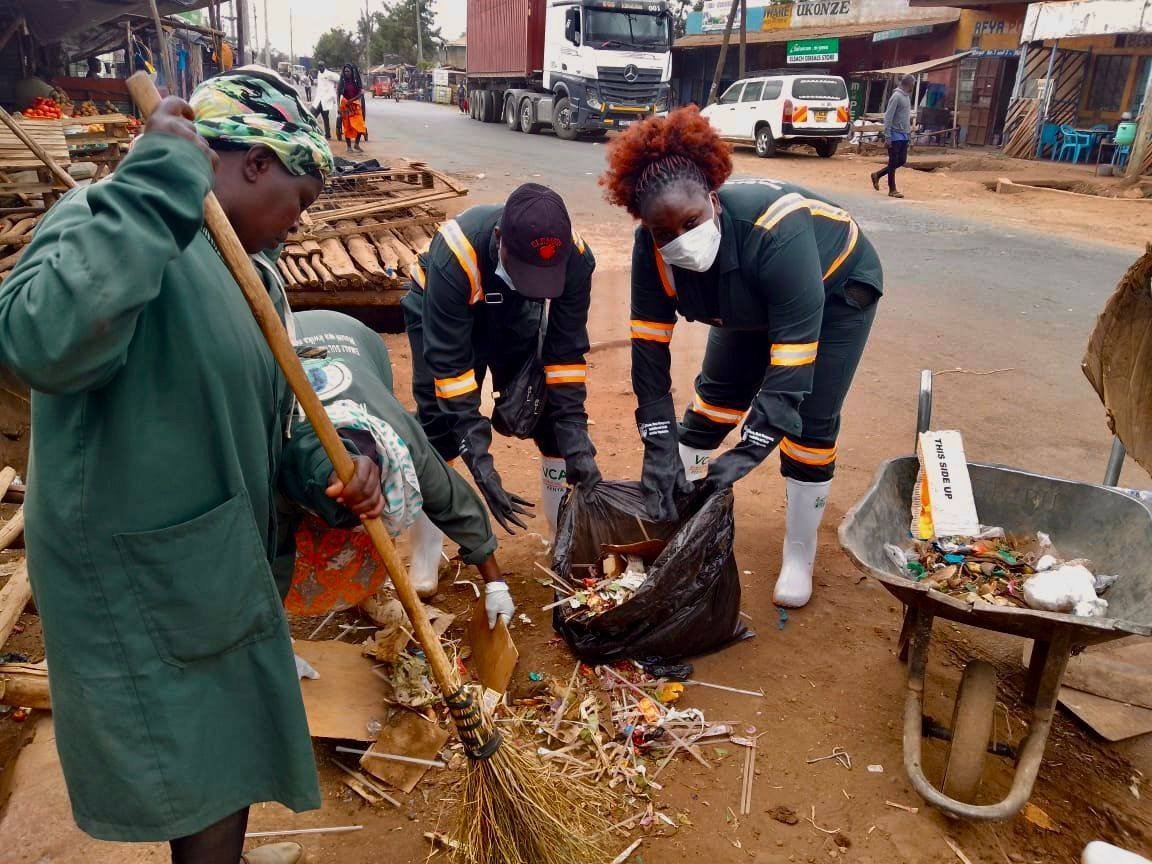
Through this initiative, CWSHI is helping reduce open dumping, improve sanitation, and complement county efforts toward sustainable waste management and environmental conservation.
Turning Waste into Opportunity
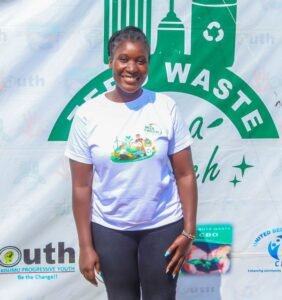 In Kisumu, Sarah Apollo—a waste actor with Miya Ywech CBO—used her learnings from NSSCJ to refine advocacy around extended producer responsibility (EPR) and the circular economy.
She now leads Zero Waste Cafés, school-based Eco-Clubs, and policy engagement with county leaders. Her advocacy pushes for social enterprise frameworks that protect and professionalize informal waste work.
“The biggest takeaway for me was understanding that climate justice means addressing historic inequalities. Africa contributes the least to the climate crisis but suffers the most. That reality drives my work now,” she shared.
Innovation and Resilience in Action
 For Meshack Otieno, founder of Amazing Grace Green Solutions in Kisumu, NSSCJ bridged local experience with continental insight.
“The training gave me tools to mobilize effectively and the confidence to engage policymakers,” he says.
Meshack’s is leading two initiatives. From Black Soldier Fly composting and plastic repurposing to flood preparedness projects, he creates employment for youth and women while addressing waste management challenges.
Empowering the Next Generation
In Makueni, Kelvin Baraka, a student and community mobilizer under A True Achievers CBO, has applied his NSSCJ learning to youth engagement and environmental stewardship.
“I applied to NSSCJ to understand how to make my community work more strategic,” Kelvin says.
He has since supported community mapping, coordinated tree planting drives, and inspired youth to participate in local development dialogues on waste and water management.
“NSSCJ helped me link equity, participation, and action,” he reflects. “That’s how we make justice real.”
SCEJU’s Role: Building Bridges Between Grassroots and Governance
Each of these leaders is part of a growing network shaped by the SCEJU project, implemented by Friedrich-Ebert-Stiftung (FES Kenya), the Civil Society Urban Development Platform (CSUDP), and the Pan African Climate Justice Alliance (PACJA).
Through mentorship, digital advocacy training (YOSUDA), and hands-on community work, SCEJU is positioning its beneficiaries not just as learners—but as shapers of public policy, community organizers, and strategic climate communicators.
What’s Next: From Voices to Influence
The NSSCJ experience reaffirmed that climate justice is local, and policy transformation begins at the community level. As SCEJU enters the next phase of implementation, these young leaders will serve as peer mentors, campaign organizers, and contributors to ongoing waste and water governance efforts across the three counties.
Their stories underscore a powerful truth: when equipped with tools, knowledge, and networks—local actors can become national change agents.
Want to see them in action? Visit sceju.csudp.net/news for testimonials, community stories, and media from the field.