
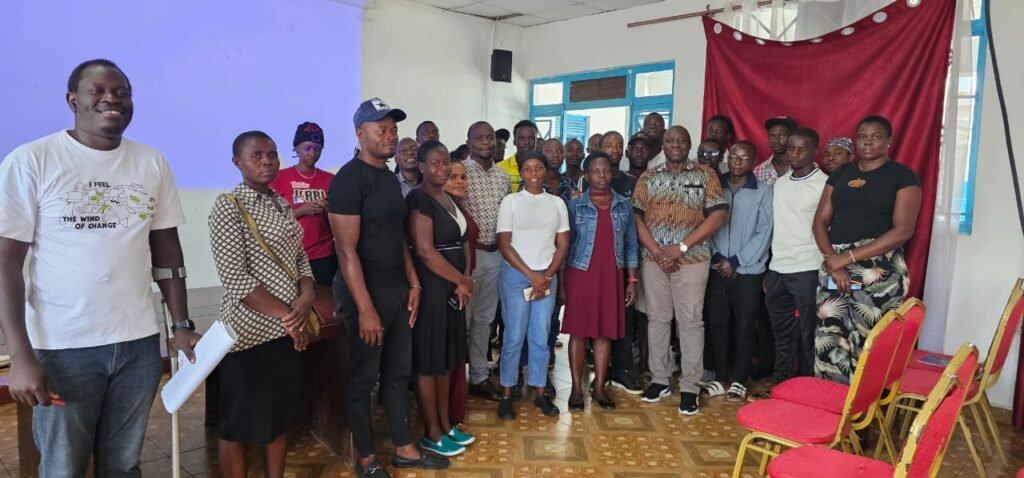
Kisumu County, July 2025 — The ongoing training of informal waste actors in Kisumu marks a critical continuation of a long-term effort under the Strengthening Civil Society Engagement for a Just and Sustainable Urbanization (SCEJU) project to build grassroots capacity for sustainable, inclusive, and dignified urban development.
Implemented by Friedrich-Ebert-Stiftung (FES-Kenya), the Civil Society Urban Development Platform (CSUDP), and the Pan African Climate Justice Alliance (PACJA)—with co-funding from the European Union—SCEJU is a three-year initiative that seeks to deepen democratic engagement in water and waste governance across Kisumu, Nakuru, and Makueni counties.
From ToTs to Community Multipliers
The current training sessions are being led by local Trainers of Trainers (ToTs)—youth and women who were capacitated in Year 1 of the project to deliver curriculum-based knowledge on waste and water management. These trainings are not one-off events. They are part of a structured, phased rollout of 300 sessions aimed at reaching over 10,500 beneficiaries (4,500 youth and 6,000 women) across the three counties.
In Kisumu alone, 50 sessions are planned for July–September 2025, focusing on practical skills, legal frameworks, safety standards, and the circular economy.
Leadership Support and Local Ownership
During the Kisumu waste actor sessions, City Director of Environment Mr. Bernard Ojwang reaffirmed the County’s commitment to institutionalizing the informal sector. He highlighted that 6 Material Recovery Facilities (MRFs) are currently operational, with a plan to establish 14 MRFs across wards to strengthen local recycling infrastructure.
Mr. Ojwang also celebrated the increasing participation of women in the waste sector and encouraged actors to take a business-oriented approach. He invited participants to seek structured support from the Department of Environment and emphasized the need for actors to be officially recognized through letters of accreditation.
However, many participants flagged the KES 6,500 fee for recognition letters as a significant barrier—especially for women and youth operating with limited resources. This concern underscores the project’s broader message: true sustainability must be inclusive and affordable.
From Marginalized Actors to Urban Change-Makers
The SCEJU capacity-building programme directly responds to findings from the project’s baseline study, which showed that informal settlements rely heavily on women and youth for essential waste and water services. Yet these actors often lack the training, policy awareness, and recognition needed to formalize and scale their contributions.
By empowering ToTs to train their peers, SCEJU enables peer-led, context-specific learning and supports community-led planning and advocacy. The trainings are designed not only to strengthen service delivery, but also to enable actors to co-produce solutions with county governments and participate in broader governance processes
Environmental Justice in Action
These sessions are unfolding against a national and global backdrop of urgent calls for climate resilience, green job creation, and the realization of just transitions for vulnerable populations. The training content aligns closely with Kenya’s Sustainable Solid Waste Management Act (2022) and the Constitution’s Articles 42 and 43, which guarantee environmental rights and access to sanitation.
Through capacity-building, SCEJU is helping communities shift from surviving the climate crisis to shaping its solutions—one session, one actor, one community at a time.